
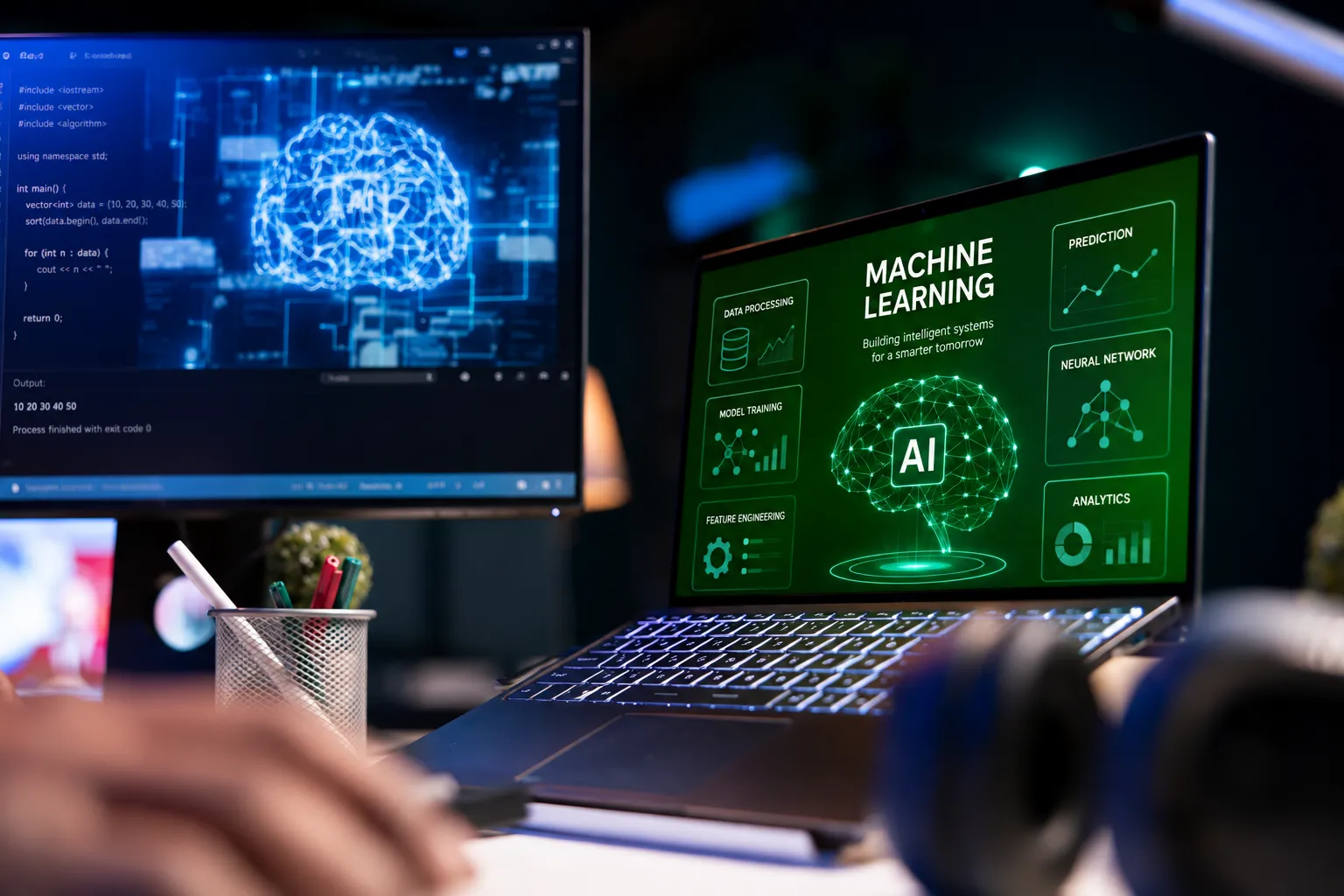
Businesses are generating more data than ever, but having large amounts of data does not automatically lead to better decisions. Organizations need intelligent systems that can identify patterns, predict outcomes, and turn complex information into useful insights. Machine Learning Development Services are helping businesses achieve this by using algorithms that can learn from data and improve their predictions over time.
From forecasting customer demand to detecting unusual transactions and automating repetitive processes, machine learning is becoming an important technology for modern enterprises. Instead of relying entirely on historical reports and manual analysis, businesses can use machine learning to support faster, more informed, and data-driven decisions.
What Is Machine Learning?
Machine learning is a branch of artificial intelligence that allows software systems to learn patterns from data without requiring every decision to be manually programmed.
A machine learning model can be trained using historical information and then used to make predictions or classifications based on new data.
For example, an e-commerce company could analyze previous customer interactions to predict which products a customer may be interested in. Similarly, a manufacturer could analyze equipment data to identify patterns that may indicate a future maintenance requirement.
The technology can be applied to structured and unstructured data, depending on the model and business requirement.
Why Machine Learning Matters for Businesses
Traditional software generally follows predefined rules. Machine learning introduces a more adaptive approach.
Instead of asking software to follow every possible rule, businesses can train models to recognize patterns and provide predictions based on available data.
This can help organizations improve several areas of their operations.
Faster Decision-Making
Machine learning can process large datasets and identify patterns much faster than manual analysis.
Business teams can use these insights to support decisions involving customers, operations, inventory, finance, marketing, and resource planning.
Improved Forecasting
Businesses often need to predict future demand, sales, customer behavior, or operational requirements.
Machine learning can analyze historical and current data to identify patterns that may help organizations prepare for different scenarios.
Process Automation
Machine learning can automate tasks involving classification, prediction, recommendations, and anomaly detection.
This can reduce repetitive manual work and allow employees to focus on higher-value activities.
Key Business Applications of Machine Learning
Predictive Analytics
Predictive analytics is one of the most valuable applications of machine learning.
Organizations can analyze historical information to estimate future outcomes.
For example, retailers can forecast product demand, financial organizations can assess risk, and logistics companies can predict delivery requirements.
The quality of predictions depends on factors such as data quality, model design, and how closely the training data represents real-world conditions.
Fraud and Anomaly Detection
Machine learning can identify patterns that differ from normal activity.
Financial institutions can use these capabilities to identify potentially suspicious transactions, while businesses in other industries can use anomaly detection to monitor systems and operational activity.
Rather than replacing human investigation, these models can help teams prioritize situations that deserve closer attention.
Customer Personalization
Customers expect increasingly personalized digital experiences.
Machine learning can analyze permitted customer interactions and preferences to generate recommendations or personalize content.
Streaming platforms can recommend content, retailers can suggest products, and digital services can customize experiences based on user behavior.
Predictive Maintenance
In manufacturing and industrial environments, equipment failures can lead to expensive downtime.
Machine learning can analyze information from machines, sensors, and maintenance records to identify patterns associated with potential failures.
Businesses can then use these insights to plan maintenance more effectively.
Machine Learning in Mobile Applications
Mobile applications are becoming an important channel for delivering AI-powered experiences.
A fitness application might use machine learning to personalize recommendations. A retail application could provide product suggestions. A financial application could offer intelligent insights based on permitted transaction data.
An experienced AI Mobile App Development Company can integrate machine learning capabilities into mobile applications while connecting them with backend systems, APIs, databases, and cloud infrastructure.
This allows businesses to create applications where AI works behind the scenes to provide more relevant and responsive experiences.
Machine Learning for Different Industries
Machine learning is not limited to a single business sector.
Healthcare
Machine learning can support medical image analysis, administrative automation, risk prediction, and research workflows when developed and validated appropriately.
Retail and E-Commerce
Retailers can use machine learning for recommendations, demand forecasting, customer segmentation, pricing analysis, and inventory planning.
Finance
Financial organizations can apply machine learning to risk analysis, fraud detection, customer insights, and forecasting.
Manufacturing
Manufacturers can use machine learning for predictive maintenance, quality inspection, production optimization, and demand forecasting.
Logistics
Logistics companies can use ML models for route optimization, delivery forecasting, inventory planning, and operational analysis.
Building a Reliable Machine Learning Solution
Developing a machine learning model is only one part of an enterprise ML project.
Businesses should consider the complete lifecycle of the solution.
Data Preparation
Good machine learning starts with relevant and reliable data. Data may need to be collected, cleaned, structured, labeled, and validated before training.
Model Development
The right algorithm depends on the business problem, available data, required accuracy, performance expectations, and deployment environment.
Testing and Evaluation
Models should be evaluated using appropriate datasets and business metrics before being deployed into production.
Deployment and Monitoring
A model can perform differently when exposed to real-world data. Continuous monitoring can help identify performance changes, data drift, and other issues.
Continuous Improvement
Machine learning is not always a one-time project. Models may need retraining and optimization as business conditions and data change.
Why Work With a Software Development Company?
Enterprise machine learning solutions often need to connect with existing applications and infrastructure.
An experienced Software Development Company can bring together machine learning, backend development, APIs, databases, cloud infrastructure, security, and user interfaces.
This integrated approach helps businesses develop complete solutions instead of isolated machine learning models.
For example, a predictive maintenance system may require machine learning models, sensor integrations, a database, an administrative dashboard, mobile notifications, and cloud infrastructure.
Having these components developed under a coordinated technology strategy can make deployment and long-term maintenance easier.
Why Choose Rushkar for Machine Learning Development?
Rushkar helps businesses explore and implement AI and machine learning solutions based on their specific requirements.
From predictive analytics and recommendation systems to anomaly detection, automation, and intelligent applications, Rushkar can support businesses throughout the development lifecycle.
The process can include understanding the business problem, preparing data, designing the solution, developing machine learning models, integrating them with existing software, testing performance, and supporting ongoing improvements.
Businesses can also work with dedicated technical professionals when they need additional development capacity for long-term AI projects.
The Future of Machine Learning in Business
Machine learning is becoming increasingly connected with other AI technologies, including generative AI, computer vision, natural language processing, and AI agents.
This combination can create more intelligent business systems capable of understanding information, predicting outcomes, and supporting automated workflows.
The future of machine learning will not simply be about building more complex models. Businesses will increasingly focus on using ML to solve specific operational problems and generate measurable value.
Conclusion
Machine learning is transforming business operations by helping organizations turn data into predictions, recommendations, and actionable insights. From predictive maintenance and fraud detection to personalization, forecasting, and automation, ML can improve how businesses operate and make decisions.
However, successful machine learning implementation requires more than selecting an algorithm. Businesses need quality data, appropriate architecture, reliable software integration, testing, monitoring, and continuous optimization.
Ready to turn your business data into smarter decisions? Partner with Rushkar to develop scalable machine learning solutions designed around your business goals. Contact Rushkar today and take the next step toward smarter automation, better insights, and data-driven growth.