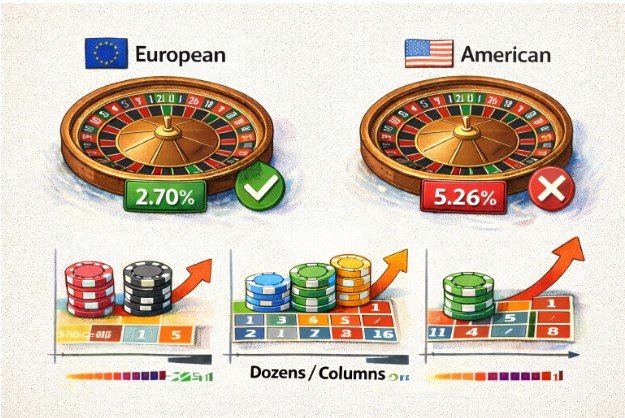
To pick the “best” roulette bet in 30 seconds, ignore the payout size and choose bets with the lowest house edge on the wheel you’re actually playing: on a European wheel (single zero), nearly all standard bets have the same expected loss rate (about 2.70% of your stake), so the practical “best bet” becomes the one that best controls volatility—typically even-money bets if you want steadier bankroll swings, or straight-up bets if you accept long droughts for occasional spikes. On an American wheel (double zero), that expected loss rate worsens (about 5.26%), and the fastest improvement you can make is switching wheel type, not changing bet type.
The 30-second method: compute expected loss, then pick volatility
Use this quick framework:
- Identify wheel type
– European: 37 pockets (0–36)
– American: 38 pockets (0, 00, 1–36)
- Check if any special rules apply
– “La Partage” or “En Prison” (even-money only, usually on European) reduces expected loss on those bets.
- Use expected loss per unit stake
– Expected loss per bet = stake x house edge (for standard rules)
- Choose bet by volatility, not “value”
– If edges are equal, your choice mostly affects variance (how jagged your results are), not long-run return.
This works because roulette payouts are designed so that, absent special rules, most bets share the same house edge; what changes dramatically is the distribution of outcomes.
Expected loss table (European vs American) you can scan instantly
Numbers below assume standard payouts and no special “half-back” rules. Expected loss is shown per 1 unit staked.
Core expected-loss table
| Bet type | Typical payout | Win probability (European) | Expected loss (European) | Win probability (American) | Expected loss (American) |
| Straight up (single number) | 35:1 | 1/37 | ~0.0270 | 1/38 | ~0.0526 |
| Split (2 numbers) | 17:1 | 2/37 | ~0.0270 | 2/38 | ~0.0526 |
| Street (3 numbers) | 11:1 | 3/37 | ~0.0270 | 3/38 | ~0.0526 |
| Corner (4 numbers) | 8:1 | 4/37 | ~0.0270 | 4/38 | ~0.0526 |
| Six-line (6 numbers) | 5:1 | 6/37 | ~0.0270 | 6/38 | ~0.0526 |
| Dozen / Column (12 numbers) | 2:1 | 12/37 | ~0.0270 | 12/38 | ~0.0526 |
| Even-money (Red/Black, Odd/Even, High/Low) | 1:1 | 18/37 | ~0.0270 | 18/38 | ~0.0526 |
Key takeaway: if you can’t change the wheel, changing between these standard bets does not improve expected loss. Your edge is set by the zeros and any special rules.
What changes the table: special rules on even-money bets
If the wheel is European and an operator applies “La Partage” or “En Prison,” even-money bets effectively refund (or defer) half the stake when the ball lands on zero, which lowers expected loss.
- European even-money with La Partage / En Prison: expected loss is about 1.35% per unit staked (roughly half of 2.70%).
- This reduction does not apply to dozens, columns, or inside bets in standard implementations.
Practical decision: if you see those rules, even-money bets become the best choice on expected loss, not merely on volatility.
Why most bets have the same expected loss (and what that means tactically)
Roulette is engineered so that payouts are slightly “short” of fair odds because of the zero(s). You can verify with a simple structure:
- Let n = total pockets (37 European, 38 American)
- Let w = winning pockets for the bet (e.g., 18 for red)
- Let payout = p to 1 (e.g., 1:1 for even-money)
Expected value per 1 unit stake:
- EV = (w/n) x p – (1 – w/n) x 1
For standard roulette bets, p is set close to (n – w)/w but not exactly; the “gap” is the house edge. Because the same zero(s) affect all bets, the gap ends up nearly identical across bet types on the same wheel.
Tactical implication: when the expected loss rate is fixed, your controllable levers are:
- wheel type (European beats American)
- special rules (La Partage/En Prison improves even-money)
- volatility (bet selection and staking pattern)
Choose the “best” bet by matching volatility to your goal
If you accept that expected loss is largely fixed, “best” becomes about controlling how quickly you might hit your stop-loss or reach a target before variance turns.
Low-volatility (bankroll smoothing)
Even-money bets (red/black, odd/even, high/low) and, to a slightly lesser degree, dozens/columns (Read more).
- Pros: more frequent wins; smaller swings; easier to stick to a plan
- Cons: wins are small; long-run loss still accrues at the same edge
Use when:
- you want to maximize time at the table for a given bankroll
- you’re using strict stop-loss/stop-win rules and don’t want immediate large drawdowns
Medium-volatility (paced risk)
Dozens and columns.
- Pros: better hit rate than inside bets, larger payout than even-money
- Cons: still experiences streaks; can drain bankroll faster than even-money if you chase
Use when:
- you want a compromise between hit frequency and payout size
- you can tolerate moderate streaks without changing stake size
High-volatility (spiky outcomes)
Inside bets (straight-up, split, street, corner, six-line).
- Pros: occasional large wins
- Cons: long losing runs are normal; bankroll can disappear quickly if stakes are not capped
Use when:
- you’re explicitly targeting a rare payout and accept that most sessions end down
- you define session risk tightly (small fixed stakes, short time horizon)
Practical shortcut: If you’re unsure, default to even-money (lowest volatility among standard bets) unless special rules or a specific risk target dictate otherwise.
A tactical worksheet: expected loss per session in under a minute
Once you know the house edge, you can estimate your “cost of play” without simulating outcomes.
- Estimate number of spins you’ll place bets on (N)
- Decide average stake per spin (S)
- Expected session loss ≈ N x S x house edge
Examples:
- European wheel, no special rules: 100 spins x 1 unit x 0.027 ≈ 2.7 units expected loss
- American wheel: 100 spins x 1 unit x 0.0526 ≈ 5.26 units expected loss
- European even-money with La Partage: 100 spins x 1 unit x 0.0135 ≈ 1.35 units expected loss
This doesn’t predict your actual result; it gives a planning number so you can choose:
- a sustainable stake size
- a realistic session length
- stop-loss limits that aren’t instantly breached by normal variance
Common “best bet” myths that waste time (and money)
“Outside bets are better because they win more”
They win more often, but the payouts are smaller, so the expected loss rate is usually the same. The real benefit is lower variance, not higher return.
“Betting systems can change the house edge”
Progressions (Martingale variants, Fibonacci, etc.) reallocate variance and can increase the chance of catastrophic loss. They do not remove the zero(s) or change payouts, so the expected loss per unit bet remains.
“Avoiding recent numbers / following hot streaks improves odds”
Each spin is (effectively) independent in standard roulette; past results don’t alter pocket probabilities on fair equipment. Pattern-following changes only your bet distribution, not the underlying edge.
One concrete example of how to verify the edge quickly
If you’re unsure what edge applies (wheel type, special rules, or bet handling on zero), check an explicit RTP/house-edge disclosure and map it to your bet choice. For example, RTP disclosure demonstrates how the stated return can differ by wheel rules and zero-handling—exactly the detail you need to decide whether even-money bets receive a reduced loss rate under La Partage/En Prison or whether you’re facing the full standard edge.
Quick Summary
On a given roulette wheel, most standard bets share the same expected loss rate; the fastest improvement is choosing a European wheel and, if available, even-money rules like La Partage/En Prison. After expected loss is fixed, pick the “best” bet by volatility: even-money for steadier swings, inside bets only if you accept long losing runs for rare spikes.